
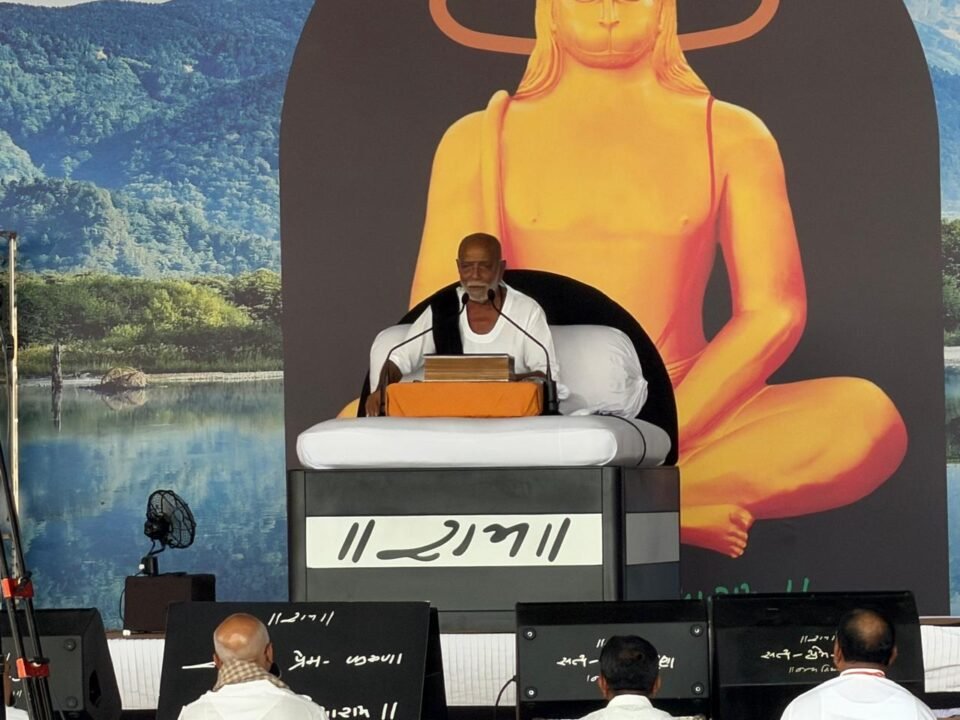
The Yatra from Dwarka to Jagannath Puri culminated with a Ram Katha at the sacred abode of Lord Jagannath, bringing together India’s diverse spiritual traditions.
JAGANNATH PURI, ODISHA | 22nd NOVEMBER 2026 | The Bharat Swastik Yatra, led by revered spiritual leader and Ramcharitmanas exponent Pujya Morari Bapu, reached its final destination of the second phase at Jagannath Puri in Odisha on November 22. The occasion was marked by a Ram Katha by Bapu at this revered pilgrimage centre, bringing the journey through India’s diverse spiritual landscapes to a close at one of the country’s most significant centres of Sanatan Dharma.
The second leg of the Yatra commenced at Dwarka on November 14 and travelled through Somnath, Dakor, Ujjain, Nagpur, Champaran in Chhattisgarh, Mayapur and Kolkata before culminating at Jagannath Puri. The journey followed the first phase from Kanyakumari to Kedarnath, connecting important pilgrimage destinations across different regions of the country.
Known by several sacred names, including Purushottama Kshetra, Shri Kshetra and Nilachala, Jagannath Puri is one of the four principal Dhams of India’s traditional Char Dham pilgrimage, alongside Badrinath, Dwarka and Rameswaram. At the heart of the city’s spiritual identity is the Shri Jagannath Temple, dedicated to Lord Jagannath, worshipped alongside his elder brother Balabhadra and sister Subhadra.
Puri’s spiritual significance extends beyond the temple itself. The annual Rath Yatra, one of the most celebrated expressions of collective devotion in Sanatan Dharma, draws millions of devotees who participate in the ceremonial journey of Lord Jagannath, Balabhadra and Subhadra on their elaborately decorated chariots. The tradition symbolises the Lord’s journey beyond the temple to offer darshan to devotees. The city’s association with Shri Chaitanya Mahaprabhu, who spent the later years of his life immersed in devotion to Lord Jagannath, further established Puri as a major centre of Krishna Bhakti and the Gaudiya Vaishnava tradition. Puri is also home to Govardhana Matha, traditionally regarded as one of the four principal monastic institutions established by Adi Shankaracharya.
Pujya Morari Bapu said, “This Bharat Swastik Katha has culminated through the divine energy of three forms of the Divine Mother – Mahalakshmi, Mahasaraswati and Mahakali. Above all, it has been made possible through the divine grace of Tribhuvan Guru Mahakala.
The Swastik of Odisha, particularly Jagannath Puri, is represented by three divine figures. Lord Krishna represents Prem (love), Balram represents the strength of Satya (truth), and Devi Subhadra represents Karuna (compassion). Along with them, Chaitanya Mahaprabhu is also an integral part of this spiritual Swastik.
The Swastik that has been formed through this sacred journey is Shashwat (eternal and perennial). It is timeless, everlasting, and no one can ever erase it.”
Organised by Santkripa Sanatan Sansthan, the Bharat Swastik Yatra is an initiative to connect India’s sacred geography and diverse cultural traditions through the ideals of Sanatan Dharma. By bringing together prominent pilgrimage destinations across the country, the Yatra seeks to highlight the spiritual traditions and shared values that have shaped India’s civilisational identity.
Speaking about the significance of concluding the second phase of the Bharat Swastik Yatra at Jagannath Puri, Madan Paliwal, Chairman, Miraj Group and Managing Trustee, Santkripa Sanatan Sansthan, said, “Jagannath Puri holds a unique place in India’s spiritual consciousness as one of the four sacred Dhams that connect the different directions of Bharat. The traditions associated with Lord Jagannath embody devotion, inclusiveness and the spirit of collective participation, values that resonate deeply with the purpose of this Yatra.”
Around 1,000 devotees accompanied Pujya Morari Bapu during the second phase of the Bharat Swastik Yatra aboard two special trains — Kailash Bharat Gaurav and Chitrakoot Bharat Gaurav, comprising 22 and 16 coaches respectively. The specially arranged train journey brought together devotees from different regions, reflecting the spirit of collective participation and shared spiritual experience that underpins the Yatra.
Together, the two phases of the Yatra, from Kanyakumari to Kedarnath and Dwarka to Jagannath Puri, spanned 13 Indian states and the Union Territory of Jammu and Kashmir. The journey brought together regions associated with different spiritual traditions, historical landmarks and river systems, reflecting the geographical and cultural breadth of the country.
The route also resonated with the spirit of India’s National Anthem, Jana Gana Mana, which evokes the country’s diverse regions, including Punjab, Gujarat, the Maratha region, Dravida, Utkala and Banga, alongside the Ganga and Yamuna, the Himalayas and the ocean. The Yatra’s passage through regions associated with several other rivers further highlighted the interconnectedness of India’s natural and cultural landscapes.
For Pujya Morari Bapu, whose Ram Kathas centre on Satya, Prem and Karuna — Truth, Love and Compassion — the Yatra was an expression of these timeless values, bringing people and communities together through spirituality and shared heritage.
The Ram Katha and associated programmes during the Yatra were free of charge and open to all. Bhandara (vegetarian community meals) was organised at every location as prasad.
=== === === === === ===
