
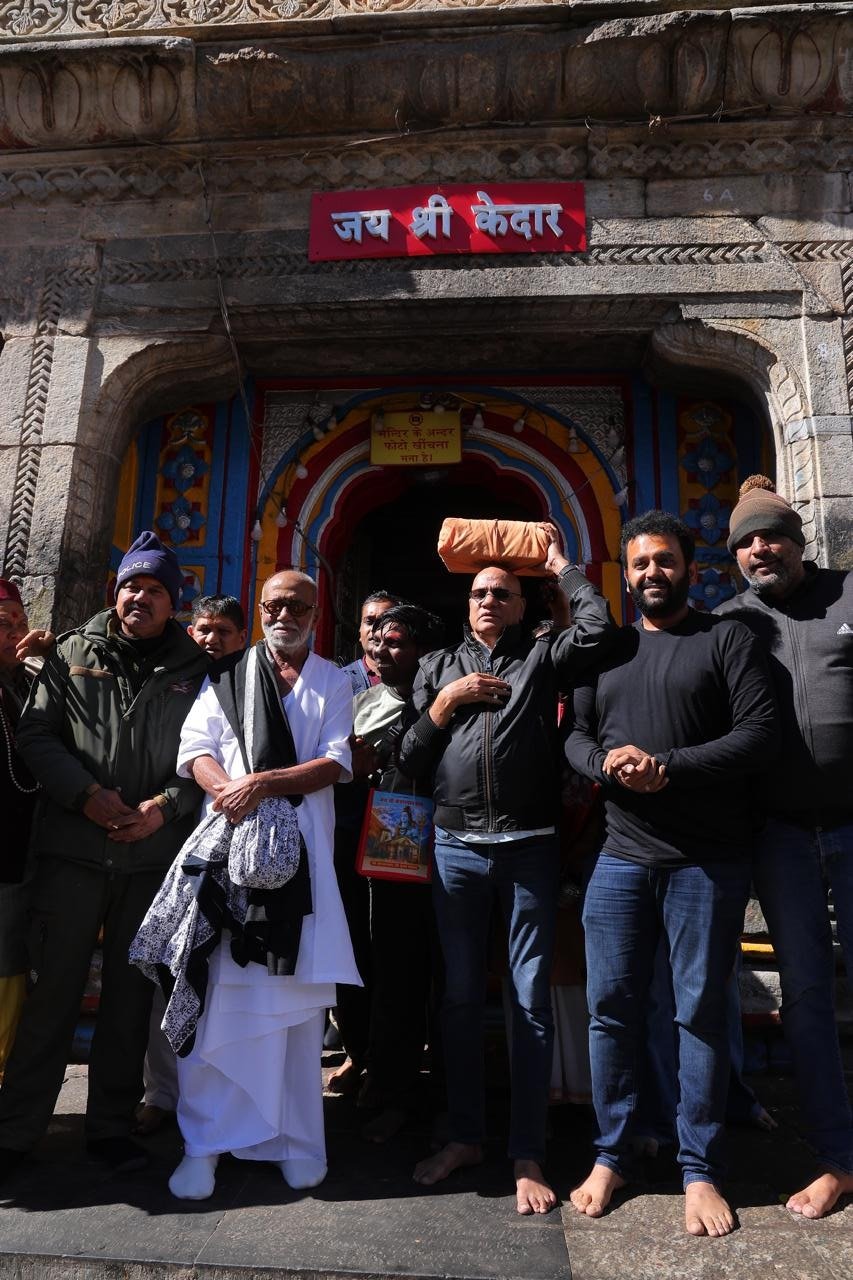
At one of Sanatana Dharma’s most revered Himalayan pilgrimage sites, Pujya Morari Bapu’s Katha highlights Kedarnath’s significance as a Jyotirlinga, its association with the Mahabharata and Adi Shankaracharya, and the spiritual traditions connecting the Himalayas with the wider sacred geography of Bharat.
KEDARNATH, UTTARAKHAND | 23rd OCTOBER 2026 | The Bharat Swastik Yatra continued its journey through India’s sacred geography as Pujya Morari Bapu held his Ram Katha at Kedarnath on October 23. Situated in the Garhwal Himalayas, Kedarnath occupies a distinctive place in Sanatana Dharma as one of the twelve Jyotirlingas of Lord Shiva and one of the four shrines of Uttarakhand’s Char Dham. Its association with the Mahabharata, Adi Shankaracharya and the ancient pilgrimage traditions of Bharat lends particular significance to this leg of the Yatra.
Located at approximately 3,580 metres in the Himalayas, Kedarnath is revered as one of the holiest Shiva tirthas in the country. The shrine stands in the sacred landscape traditionally known as Kedar Khand, near the source region of the Mandakini River. Its imposing stone structure, distinctive natural form of the Shiva lingam and dramatic mountain setting have made it a central destination for pilgrims seeking the blessings of Lord Shiva.
Kedarnath holds a profound association with Adi Shankaracharya, the philosopher-saint who played a pivotal role in strengthening Sanatana Dharma and renewing pilgrimage and monastic traditions across Bharat. Tradition holds that Adi Shankaracharya attained his final liberation near Kedarnath, where the Adi Shankaracharya Samadhi stands behind the temple. His association with the shrine connects the Himalayan pilgrimage tradition with the wider spiritual geography of Bharat, extending from the northern mountains to the southern peninsula.
Pujya Morari Bapu said, “Adi Shankaracharya’s Swastik was formed through Gangotri, Yamunotri, Badrinath and Kedarnath, with Kedarnath marking the final point, where he is believed to have become Antardhan and disappeared from the earthly plane. Rameshwaram, Dwarka, Badrinath and Kedarnath are regarded as the four Dhams, but Adi Shankaracharya’s journey through Gangotri, Yamunotri, Badrinath and Kedarnath also came to represent a natural Swastik in the Himalayas.
The Bharat Swastik Yatra is an endeavour towards national integration and, through India, an effort to take the message of unity to the entire world.
During the Katha, I shared a Sakhi attributed to an unknown writer, whom I referred to as Abdul. What is remarkable is that this Sakhi appears to envision a Swastik Yatra much before our time. It speaks of a journey beginning in the south and moving north, followed by a journey from the east and then from the west towards the east. It also mentions four essential elements: Bhiksha, Bhajan, Samadhi and Samved. These four elements resonate deeply with my own spiritual path and the Nimbarki Parampara. It is as though someone had anticipated, long ago, that a journey of this nature would one day take place.”
The spiritual geography surrounding Kedarnath encompasses several important pilgrimage sites and traditions. Gaurikund is associated with Goddess Parvati’s penance to attain Lord Shiva, while Bhairavnath is revered as the guardian deity of Kedarnath. During the winter months, when the main shrine becomes inaccessible due to heavy snowfall, worship continues at the Omkareshwar Temple in Ukhimath, preserving the ritual continuity of the pilgrimage. Together, these traditions reflect the close relationship between the natural landscape of the Himalayas and the spiritual practices of Sanatana Dharma.
Kedarnath’s place among the twelve Jyotirlingas connects it with sacred Shiva shrines spread across Bharat. Its inclusion in the Uttarakhand Char Dham, alongside Yamunotri, Gangotri and Badrinath, further establishes its importance within the country’s pilgrimage traditions. Through its association with Lord Shiva, the Pandavas and Adi Shankaracharya, Kedarnath represents a meeting point of scriptural traditions, philosophical thought and the living practices of devotion that have shaped Bharat’s civilisational heritage.
The Bharat Swastik Yatra is being shaped around a national vision of connecting India’s spiritual heritage and national identity. Alongside covering the four Peethas established by Adi Shankaracharya and Omkareshwar, which holds a deep spiritual connection with the philosopher-saint, the journey is covering every state and river mentioned in India’s National Anthem. The route brings together diverse regional histories and sacred traditions within a shared cultural framework.
The Bharat Swastik Yatra is being organised by Santkripa Sanatan Sansthan under the guidance of Pujya Morari Bapu.
Speaking on the significance of the Katha at Kedarnath, Madan Paliwal, Chairman, Miraj Group and Managing Trustee, Santkripa Sanatan Sansthan, said, “Kedarnath represents the extraordinary continuity of Bharat’s spiritual heritage, where the traditions of Lord Shiva, the legacy of Adi Shankaracharya and the wisdom of our ancient scriptures remain deeply connected with the lives of people. Through the Bharat Swastik Yatra, our endeavour is to bring these sacred traditions into focus and highlight the values of dharma, harmony and universal welfare that unite our country.”
The Ram Katha at Kedarnath forms part of the first phase of the Bharat Swastik Yatra, which began in Kanyakumari on October 10 and culminated at Kedarnath on October 23, 2026.
For Morari Bapu, whose Ram Katha is rooted in the values of Satya, Prem and Karuna — Truth, Love and Compassion — the Yatra is an opportunity to take these values across the country and bring people together through a shared spiritual and cultural heritage.
The Ram Katha and associated programmes during the Yatra remain open to all. In keeping with Bapu’s tradition of inclusivity and service, bhandara (free vegetarian community meals) is organised at every location, with meals served daily as prasad.
== ENDS ==
