
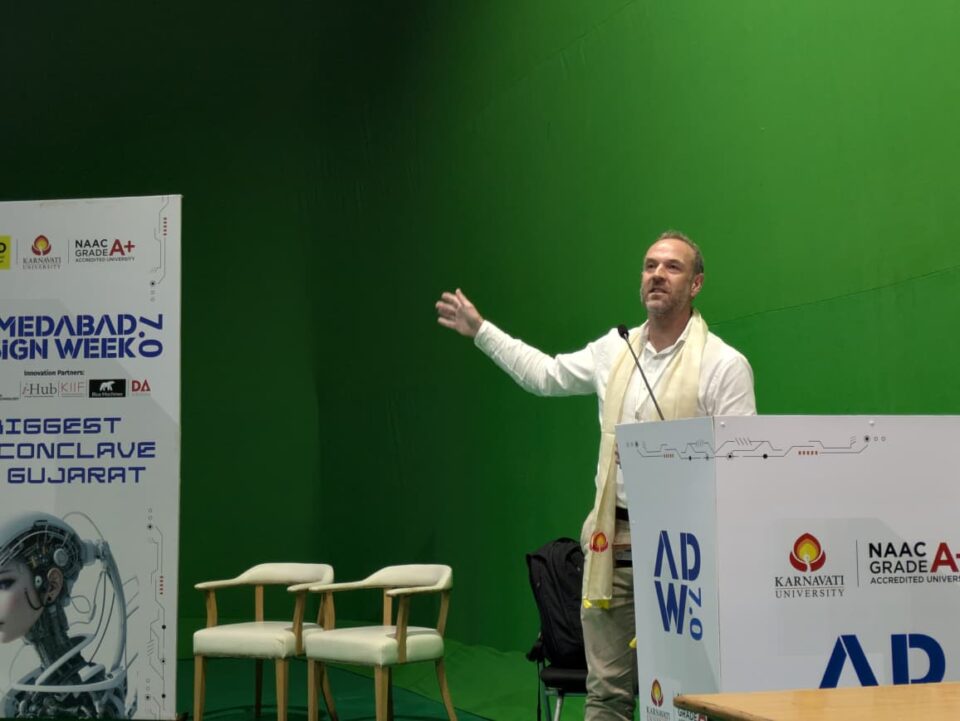
AHMEDABAD, GUJARAT | 01st FEBRUARY 2026 — The third and concluding day of Ahmedabad Design Week (ADW) 7.0 marked a decisive shift in the ongoing conversation around Artificial Intelligence—moving beyond tools and trends to address responsibility, ethics, and human intent. Through keynotes, workshops, and conversations, Day Three placed designers at the centre of an AI-driven future, asking a critical question: What happens when intelligence becomes embodied and begins to act in the real world?
Across sessions, a clear message emerged—while AI may accelerate execution, it is human-led, ethical, and contextual design that must guide direction.
From Intelligence to Embodiment
The day opened at the Hutheesing Visual Arts Centre (HVAC) with a keynote by Dr. Ramachandra Budihal, General Manager and Global Head of Autonomous Driving and Robotics at Wipro Limited, on “The Convergence of Generative Intelligence and Robotics.”
Describing the current moment as a technological “phase change,” Dr. Budihal explained how intelligence is moving beyond screens into physical systems—what he termed Embodied Intelligence. Unlike digital outputs, physical systems operate under real-world constraints such as gravity, energy, and time, making errors irreversible.
He introduced the concept of “Delegated Imagination,” where AI can generate infinite possibilities but lacks conscious intent—making ethics, safety, and human judgement critical in the design of autonomous systems.
AI in Practice: From Concept to Creation
Bringing hands-on application to the day, Alicia Faleiro, Digital Media Creative Solutions Consultant at Adobe, led a dynamic Creative Jam & Design Challenge. Participants worked in teams using Generative AI across Adobe tools such as Photoshop, Illustrator, and Premiere Pro to create environmental renders, cinematic storyboards, and AI-assisted video content.
The workshop demonstrated how AI can significantly compress the journey from ideation to production—while reinforcing that creative ownership and intent remain firmly human.
Rethinking the Designer’s Role
Addressing a common concern among students—Will AI replace designers? —multiple sessions offered clarity and reassurance.
Manish Maheshwari, General Partner and India Head at BAT-VC, in his session “The Future Designer: Skills that Will Matter in an AI-First World,” argued that while AI has commoditised speed and polish, differentiation now lies in Judgement, Judicious taste, and Justification. He urged designers to move upstream—from execution to intent—positioning AI as a thought partner, not a master.
Echoing this, Gaurav, Head of Design at Flipkart, highlighted that empathy, user-centricity, and conceptual clarity remain irreplaceable. Through industry case studies, he showed how AI enables scalable design systems—when guided by strong human vision.
Human Creativity Vs Machine Output
A counterbalance to automation-led narratives came through Urvi Bansal, jewellery designer and founder of Urvi Bansal Studio, whose workshop on Radical Creativity foregrounded emotion, materiality, and making. Participants transformed personal memories into physical forms before testing them through AI—revealing the limitations of algorithmic generation when compared to lived, sensory experience.
Similarly, Anil Reddy, Founder of Happy Pet and former Design Director at Lollypop, dismantled common design myths, emphasising that strong fundamentals—not tools—form the foundation of meaningful design.
Enterprise, Ethics, and Scale
In a fireside chat titled “Scaling High-Stakes Design at Finance Giants,”Rahul Saini, Chief Design Officer at Paytm, discussed designing for trust, inclusion, and reliability in fintech products serving millions of Indian users.
Rasesh Shah, Chief Practice Officer at Fractal AI, expanded the conversation to enterprise ecosystems, highlighting how falling AI costs and increased accessibility are accelerating adoption—making ethical foresight and accountability more important than ever.
Design Beyond Humans
The day concluded with a reflective workshop led by Archana Surana, Board Member of the Cumulus Association, centred on the Cumulus Design Declaration. Calling for a shift from human-centred to planet-centred design, she positioned sustainability and planetary well-being as core design responsibilities. Students translated global design ethics into actionable, locally relevant ideas.
A Thoughtful Close
As ADW 7.0 concluded, its message was unambiguous: AI is not the end of design thinking—it is its next test. As intelligence becomes embodied, autonomous, and scalable, the responsibility placed on designers grows heavier.
Ahmedabad Design Week 7.0 closed not with definitive answers, but with sharper questions—about ethics, authorship, intent, and care—leaving participants better equipped to ensure that as technology advances, humanity continues to lead.
¤¤¤¤ ¤¤¤¤ ¤¤¤¤ ¤¤¤¤
