
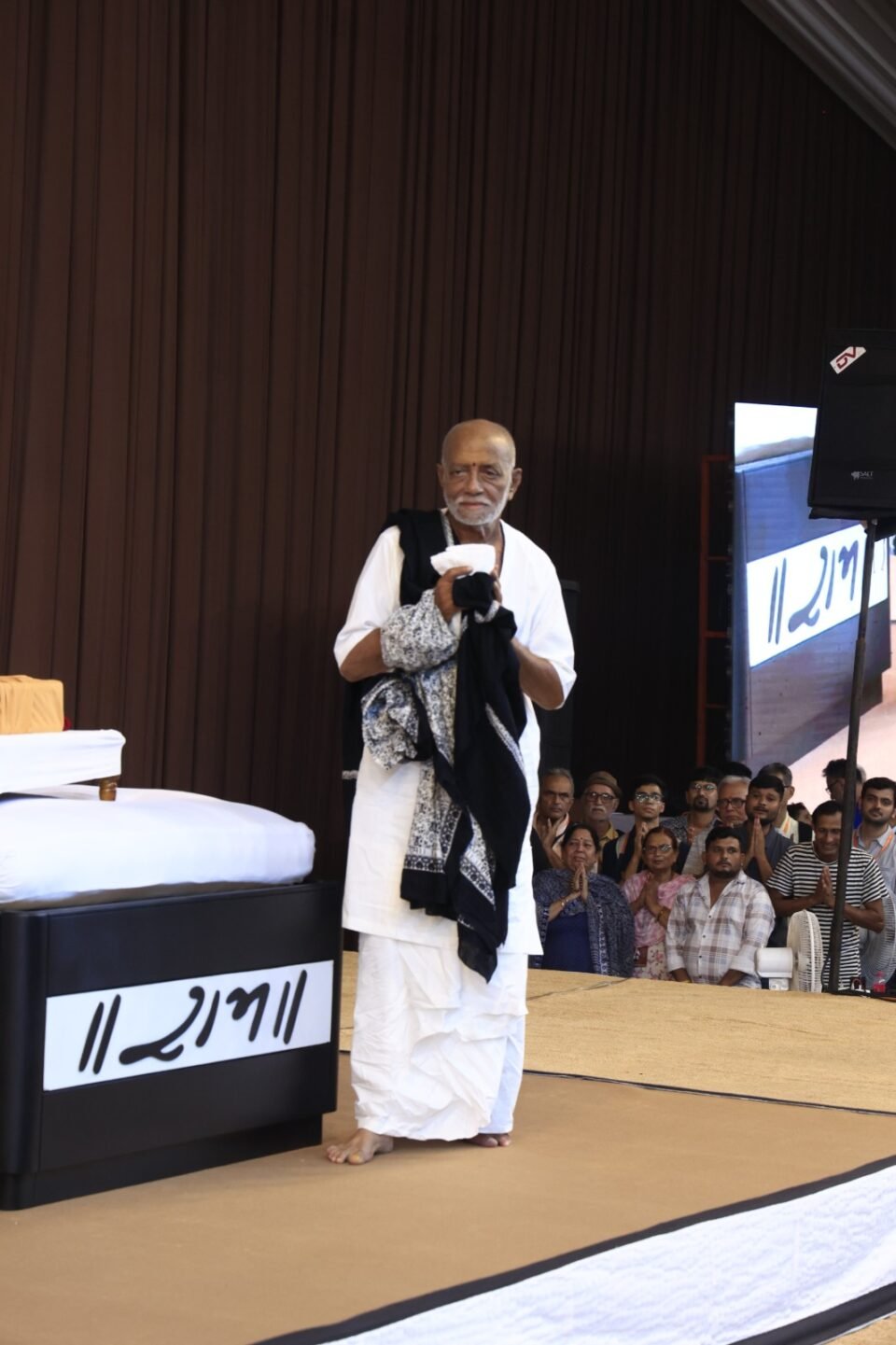
¤ The Ram Katha in Kolkata brought together the city’s rich spiritual traditions and its legacy of devotion, knowledge and India’s cultural renaissance.
KOLKATA, WEST BENGAL | 20th NOVEMBER 2026 | From its revered temples dedicated to Goddess Kali to its legacy of spiritual thinkers and social reformers, Kolkata holds a distinctive place in India’s religious and cultural history. The Bharat Swastik Yatra, led by revered spiritual leader and Ramcharitmanas exponent Pujya Morari Bapu, reached Kolkata on November 21, with the occasion marked by a Ram Katha by Bapu. The visit brought the Yatra to a city whose heritage reflects the diverse expressions of Sanatan Dharma, spiritual inquiry and India’s cultural awakening.
The second leg of the Yatra began at Dwarka on November 14 and is travelling through Somnath, Dakor, Ujjain, Nagpur, Champaran in Chhattisgarh, Mayapur and Kolkata before culminating at Jagannath Puri on November 22.
Around 1,000 devotees are accompanying Pujya Morari Bapu during the second phase of the Bharat Swastik Yatra aboard two special trains — Kailash Bharat Gaurav and Chitrakoot Bharat Gaurav, comprising 22 and 16 coaches respectively. The specially arranged train journey brings together devotees from different regions, reflecting the spirit of collective participation and shared spiritual experience that underpins the Yatra.
Reflecting on the spiritual significance of Kolkata, Pujya Morari Bapu said, “The Swastik of Kolkata comprises four great spiritual personalities and divine manifestations: Thakur Sri Ramakrishna Paramahamsa, Maa Sharda, Swami Vivekananda and Maa Kali. Thakur represents Gyan (knowledge), Maa Sharda represents Bhakti (devotion), Swami Vivekananda represents Karma (action), and Maa Kali represents Shakti (divine power). The Bindu, or central point, of this Swastik is Maa Ganga, whose presence completes and unites this spiritual symbolism.
He also have fond memories of my earlier visits to Kolkata, many years ago. I had the opportunity to deliver a pravachan in the temple hall at Dakshineswar. Remembering that association with this sacred land makes this visit particularly meaningful for him.”
Kolkata’s spiritual identity is reflected in several prominent pilgrimage destinations, including the Kalighat Kali Temple, regarded as one of the important Shaktipeeths associated with Goddess Sati, and the Dakshineswar Kali Temple, established by Rani Rashmoni in 1855. Dakshineswar is closely associated with the spiritual life and teachings of Sri Ramakrishna Paramahansa, whose philosophy later inspired the Ramakrishna Movement and influenced his foremost disciple, Swami Vivekananda. Belur Math, established by Swami Vivekananda on the banks of the Hooghly, continues this legacy through its emphasis on spiritual practice, service and religious harmony.
Beyond its religious landmarks, Kolkata emerged as a major centre of intellectual and cultural activity during the Bengal Renaissance of the 19th and early 20th centuries.
The katha that is being organised by Santkripa Sanatan Sansthan, the Bharat Swastik Yatra is an initiative to connect India’s geography and diverse cultural traditions through the ideals of Sanatan Dharma.
Speaking about the significance of including Kolkata in the Bharat Swastik Yatra, Madan Paliwal, Chairman, Miraj Group and Managing Trustee, Santkripa Sanatan Sansthan, said, “Kolkata represents a remarkable confluence of spirituality, knowledge and cultural awakening in India’s history. From the traditions of Shakti worship and the teachings of Sri Ramakrishna and Swami Vivekananda to the Bengal Renaissance, the city has made an enduring contribution to India’s spiritual and intellectual heritage.”
Together, the two phases of the Yatra, from Kanyakumari to Kedarnath and Dwarka to Jagannath Puri, span 13 Indian states and the Union Territory of Jammu and Kashmir. The journey brings together regions associated with different spiritual traditions, historical landmarks and river systems, reflecting the geographical and cultural breadth of the country.
The route also resonates with the spirit of India’s National Anthem, Jana Gana Mana, which evokes the country’s diverse regions, including Punjab, Gujarat, the Maratha region, Dravida, Utkala and Banga, alongside the Ganga and Yamuna, Mandakini, Alakhnanda, the Himalayas and the ocean. The Yatra’s passage through regions associated with several other rivers further highlights the interconnectedness of India’s natural and cultural landscapes.
For Pujya Morari Bapu, whose Ram Kathas centre on Satya, Prem and Karuna — Truth, Love and Compassion — the Yatra is an expression of these timeless values, bringing people and communities together through spirituality and shared heritage.
The Ram Katha and associated programmes during the Yatra are free of charge and open to all. Bhandara (vegetarian community meals) is organised at every location as prasad.
== ENDS ==
